
Kyle Shanahan, the NFL coach at the centre of Michael Silver’s book of the same name, has a reputation: a single 30-minute meeting with him teaches players more than their entire football career. Not the plays. Not the mechanics. The why — the principle underneath every decision, the reasoning that makes a play work in the context of a scheme, the understanding that outlasts any single Sunday.
Players don’t leave those meetings knowing more X’s and O’s. They leave understanding why the X’s and O’s matter.
That’s teaching that sticks because it transfers. A player who understands the principle can adapt when circumstances change. A player who only knows the play drowns when something unexpected happens. Shanahan doesn’t teach plays. He teaches frameworks. And once you understand the framework, you can build inside it forever.
The same discipline applies to Azure adoption. And like Shanahan’s method, it gets skipped more often than it should.
Why the Cloud Adoption Framework exists
Microsoft’s Cloud Adoption Framework (CAF) has seven phases. But the most critical, the one that determines whether the other six succeed, is the first: Strategy. Not the tools. Not the landing zones. Strategy. The “why” of your cloud adoption.
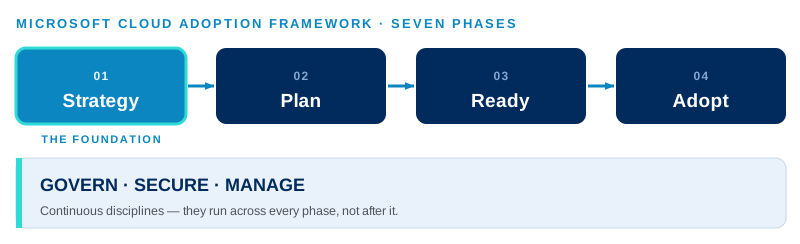
The CAF’s seven phases. Strategy leads the sequence — and Govern, Secure and Manage run throughout — because everything after it depends on the why.
Strategy answers the hard questions before you touch a deployment. Why are you moving to Azure? What business outcomes matter? How will the cloud solve a real problem? But here’s what most adoptions miss: Strategy isn’t just for executives. It’s where you answer how the cloud changes daily work for developers. How operations will run it. How business processes shift. What new skills people need. What everyone’s role becomes in the new world.
Without those answers locked in, you get organisational misalignment. IT builds a platform. Developers won’t use it because nobody asked how they actually work. Operations struggles to run what they didn’t help design. The business never sees ROI because no one defined outcomes with them in the room. That’s not a technical failure. That’s an organisational one.
The cost of treating adoption as an IT project
Here’s what I see constantly: organisations frame cloud adoption as infrastructure work. IT plans it. Architects design it. Engineers build it. Business leadership isn’t in the room. Developers aren’t consulted. Operations doesn’t sit at the table. Process change is treated as someone else’s problem — or not treated at all.
That’s where Strategy gets abandoned. Not because it feels slow, but because adoption is framed as technical, not transformational. And transformation requires everyone.
A developer’s first reaction to the new platform is “this doesn’t match how I work.” Operations inherits runbooks that assume knowledge they don’t have. The business wonders why the cloud costs more than the data centre. Finance questions the spend because nobody explained the value. All of that happens because Strategy — the one phase that brings everyone into alignment — was skipped.
The symptoms are always the same: resentment, workarounds, cost surprises, governance policies that nobody understands, and a platform that works technically but delivers nothing organisationally.
Strategy is where alignment happens
The CAF Strategy phase asks:
- What motivated this decision? Who defined it, and did business and IT agree?
- How will developers’ day-to-day change? Did you ask them?
- How will operations run this? What skills do they need to learn?
- What does success look like in 12 months? Did the business define it, or did IT assume?
- What process changes are required? Who owns them?
- Who drives cost optimisation, and by what rules?
Those answers sound soft. They’re not. They’re constraints that make hard technical decisions straightforward. When Strategy includes developers and asks “how do you want to deploy code?”, architecture decisions follow that principle. When operations sits at the table and says “we need observability built in from day one,” monitoring becomes foundational, not optional. When the business defines outcomes, spending becomes purposeful.
Strategy is where you make cloud adoption a shared mission, not an IT mandate.
It’s never too late
Here’s what matters most: if you’re already in Azure and you skipped Strategy, you haven’t locked yourself in. You can go back.
I’ve worked with organisations three years into an adoption, paying through the nose for complexity nobody understands, developers bypassing the platform to solve problems themselves, operations running it blind because they were never trained, and business leadership wondering why the cloud didn’t transform anything. And yes, there’s work to do. You can’t unspool what you’ve built. But you can ask the Strategy questions now. You can audit your estate against the business outcomes you should have defined years ago. You can bring developers and operations into the conversation. You can correct your course.
That’s what the CAF is for. It’s not a once-and-done at the beginning. It’s a framework you return to. I’ve written about this — how even organisations deep in Azure can use Strategy and the Microsoft Cloud Adoption Framework to reset their adoption, realign to actual business needs, include the teams who run it daily, and stop paying for decisions that nobody made consciously.
The parallel
Shanahan teaches the why before the play because he knows that principle outlasts any single Sunday. The same is true for your adoption. Spending time on Strategy — naming your drivers, your constraints, your non-negotiables, and making sure business, IT, developers, and operations all agree — is time that compounds.
Teams that start with Strategy, all together, know why every resource they build matters. Developers understand the trade-offs. Operations can run it with confidence. The business sees the outcomes it paid for. Teams that skip it build a lot and understand none of it. Worse, they build resentment alongside the infrastructure.
Start now
Whether you’re planning your first workload in Azure or you’re three years deep and watching developers go around the platform to get work done, the question is the same: does everyone — business, IT, developers, operations — agree on why this adoption matters and what success looks like? If the answer is no, that’s where to start.
Book a consultation to work through your adoption strategy with the full team, or if your estate is already live and fracturing under misalignment, get your Azure environment reviewed — we’ll help you reset the why and bring everyone back into sync.